
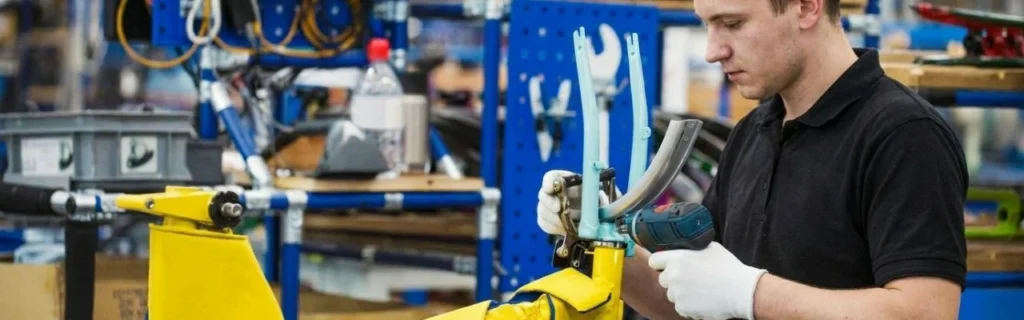

Every square foot on your production floor costs money. Deciding between kitting and line-side stocking isn’t just a material handling choice; it’s deciding whether you’d rather sacrifice floor space or risk assembly errors in a high-variance environment.
What is Line-Side Stocking?
Line-side stocking is a material presentation system where individual components are stored in dedicated locations directly at or near assembly workstations. Operators retrieve the specific parts they require from these point-of-use storage areas as they complete each assembly step.
This approach maintains continuous availability of all required SKUs at the production line, eliminating the need for upstream kit preparation processes.
The method works by establishing designated storage zones adjacent to each workstation, typically using shelving, bins, or flow racks that hold multiple units of each component. Material handlers replenish these locations based on consumption rates, often using kanban signals or scheduled delivery routes.
Line stocking is often operationally simpler and can be more suitable for high-volume, low-variety production environments since parts are continuously available at the line and do not require the extra handling step of kitting and kit preparation.
Key Characteristics of Line-Side Inventory
Line-side stocking systems share several defining features that distinguish them from alternative material presentation methods:
- Continuous component availability: All parts needed for production remain accessible at the workstation throughout the shift, reducing the risk of line stoppages due to material shortages.
- Higher floor space requirements: Line stocking can require more line-side space and material handling equipment since many SKUs must be stored and replenished at the workstation, which can increase walking distances and searching time for operators.
- Individual SKU management: Each component is tracked, stored, and replenished as a separate inventory item, requiring robust systems to maintain accuracy across potentially hundreds of part numbers at a single workstation.
- Frequent replenishment cycles: High-volume production consumes components quickly, necessitating regular material handler visits to prevent stockouts and maintain production flow.
- Operator selection responsibility: Assembly workers must locate and retrieve the correct parts from available inventory, which introduces potential for picking errors in complex, high-mix environments.
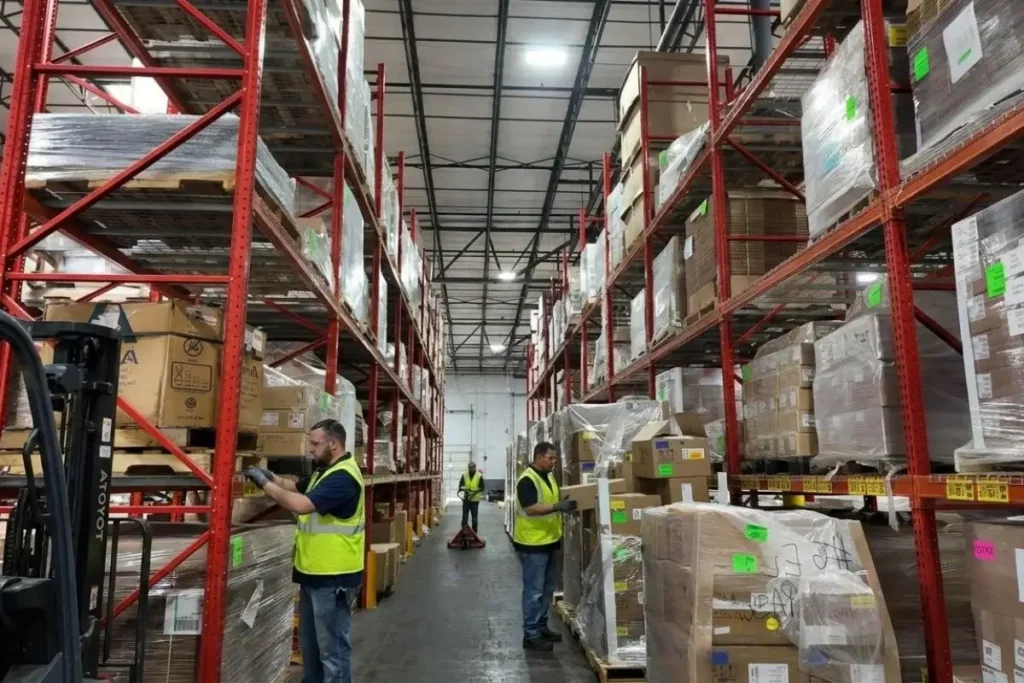
Industries Where Line-Side Stocking Excels
Certain manufacturing sectors find line-side stocking particularly well-suited to their operational characteristics:
- Automotive high-volume assembly
- Consumer electronics mass production
- Appliance manufacturing
- Industrial equipment production
What is Kitting in Manufacturing?
Kitting is a material presentation strategy where specific components required for a particular product, assembly step, or work order are pre-selected, grouped together, and delivered to the production line as a complete set.
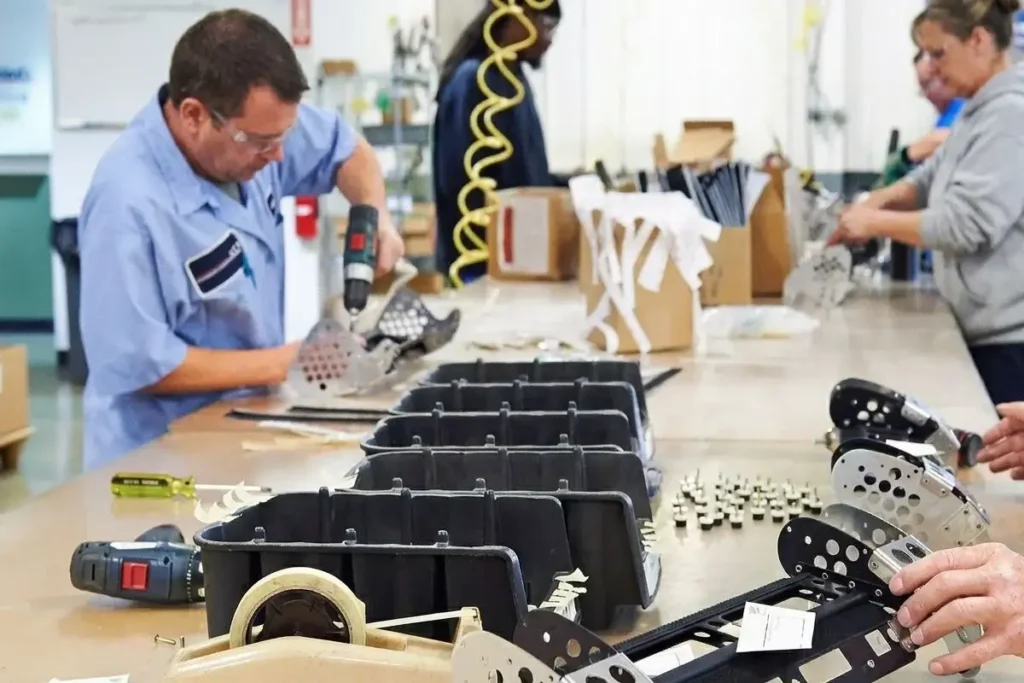
The kitting process begins upstream from the assembly line, typically in a dedicated staging area where material handlers or automated systems pick individual components based on bills of materials.
These components are then organized into containers, totes, or carts that correspond to specific production orders or assembly sequences. Once prepared, kits are delivered to workstations precisely when needed, synchronized with the production schedule.
This approach transforms material delivery from a continuous replenishment model to a synchronized, demand-driven system. By pre-assembling component sets, kitting shifts the burden of part selection and verification away from assembly operators, allowing them to focus exclusively on value-added assembly tasks.
For manufacturers implementing kitting in ecommerce fulfillment or complex assembly operations, this method provides superior control over component accuracy and inventory visibility.
Core Components of a Kitting System
Effective kitting operations require several integrated elements working in coordination:
- Dedicated kitting stations: Designated areas equipped with shelving, picking tools, and verification systems where material handlers assemble kits away from the production line, preventing congestion in assembly areas.
- Bill of materials (BOM) integration: Digital systems that communicate exact component requirements for each product variant, ensuring kits contain precisely the right parts in the correct quantities.
- Kit packaging and identification: Containers, labels, or RFID tags that clearly identify kit contents, destination workstations, and production order associations, enabling traceability throughout the assembly process.
- Synchronized delivery schedules: Coordinated timing systems that ensure kits arrive at workstations just-in-time for assembly, supporting lean manufacturing principles without creating line-side inventory buildup.
Kitting introduces additional upstream processes such as picking, kit assembly, and verification, which can increase handling complexity and require accurate material planning (often supported by MRP/ERP systems).
Manufacturing Environments Best Suited for Kitting
Kitting delivers maximum value in specific production scenarios where its benefits outweigh the additional handling complexity:
High-mix, low-volume assembly: Operations producing numerous product variants with different component requirements benefit from kitting’s ability to present exactly the right parts for each configuration, eliminating operator confusion and picking errors.
Complex assemblies with many SKUs: Products requiring dozens or hundreds of different components gain significant quality improvements from pre-verified kits. Kitting is frequently used in high-mix or complex assembly environments because it supports better control of components for each product variant, reduces the risk of using incorrect parts at the line, and can support just-in-time (JIT) principles.
Custom or build-to-order manufacturing: Production environments where each unit is configured to customer specifications rely on kitting to ensure the correct components are available for each unique build.
Medical device assembly: Industries with stringent traceability and quality requirements use kitting to maintain lot control and ensure regulatory compliance through verified component sets.
Direct Comparison: Kitting vs Line-Side Stocking
The right choice depends on product variety, line layout, and quality requirements.
| Dimension | Line-Side Stocking | Kitting |
|---|---|---|
| Floor Space | Requires significant line-side area for multiple SKUs | Minimal line-side footprint; components stored upstream |
| Labor Model | Operators select parts; material handlers replenish | Material handlers prepare kits; operators assemble only |
| Inventory Accuracy | Higher risk of picking errors at line | Pre-verification reduces assembly errors |
| Flexibility | Difficult changeovers in high-mix environments | Rapid adaptation to product variations |
| Operational Complexity | Simple replenishment processes | Requires upstream planning and coordination |
| Best Fit | High-volume, low-variety production | High-mix, complex assembly operations |
At EP Logistics, we manage high-complexity kitting and VMI (Vendor Managed Inventory) operations right across the US-Mexico border. We see first-hand how offloading the kitting process to an asset-based 3PL facility in El Paso or Juarez allows manufacturers to reclaim up to 30% of their production floor space while maintaining just-in-time delivery.
Space Utilization and Floor Layout Impact
The physical footprint of material presentation systems directly affects manufacturing capacity and workflow efficiency.
Kitting can reduce the amount of material stored at the assembly line because only the parts required for a specific product or set of operations are presented, which can lower congestion and improve ergonomics.
Line-side stocking demands dedicated floor space for every SKU used at a workstation, often requiring extensive shelving, flow racks, or bin systems that consume valuable square footage.
Labor Requirements and Operational Efficiency
The distribution of labor between material handling and assembly tasks differs fundamentally between these approaches.
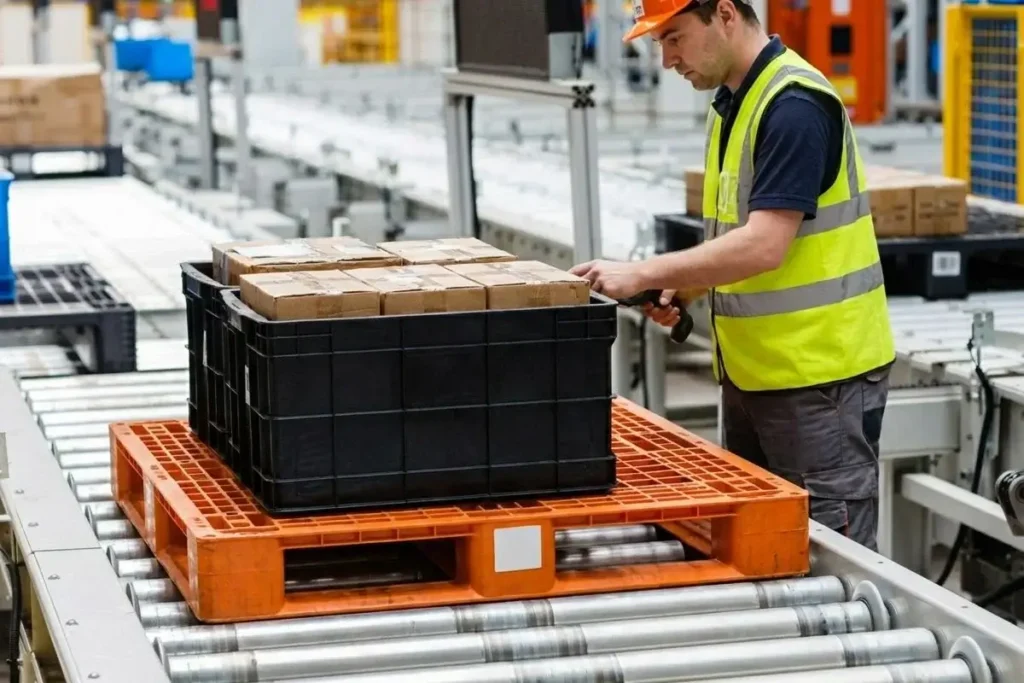
Line-side stocking places component selection responsibility on assembly operators, who must locate, retrieve, and verify parts while performing assembly tasks.
This dual responsibility increases cycle times and introduces opportunities for errors, particularly in environments with numerous similar-looking components. Material handlers focus primarily on replenishment, a relatively straightforward task that requires less coordination with production schedules.
Inventory Accuracy and Quality Control
Component accuracy directly impacts product quality, rework costs, and customer satisfaction. Kitting provides inherent advantages in error prevention through upstream verification processes.
When material handlers prepare kits in controlled environments with access to verification tools, scanning systems, and bills of materials, they can confirm component accuracy before parts reach the assembly line.
Line-side stocking relies on operator vigilance to select correct components from available inventory. In high-mix environments with similar-looking parts or frequent product changeovers, this approach increases the risk of assembly errors. Once an incorrect part is installed, detecting and correcting the error becomes significantly more expensive than preventing it through pre-verified kits.
For manufacturers implementing complete inventory management techniques and systems, kitting enables better traceability by associating specific component lots with production orders, supporting quality investigations and regulatory compliance requirements.
Flexibility and Changeover Speed
Production environments increasingly demand rapid adaptation to changing product mixes and customer orders. Kitting excels in high-mix scenarios by delivering precisely the components needed for each product variant, eliminating the need to reconfigure line-side storage locations for different products.
Line-side stocking struggles with product variety because each new variant potentially requires different components at the workstation. Adding SKUs means adding storage locations, consuming more floor space and increasing operator search time. Changeovers may require physically removing components for one product and installing storage for another, creating downtime and complexity.
When to Use Line-Side Stocking
Line-side stocking works best when…
- High-volume, low-variety production: When manufacturing thousands of identical or nearly identical units daily, the simplicity of continuous component availability justifies the floor space investment. Automotive assembly lines producing a single model or consumer electronics plants building standardized products exemplify this scenario.
- Stable production schedules: Operations with predictable, repetitive assembly sequences benefit from line stocking’s straightforward replenishment processes. When the same components are used in the same quantities day after day, the system requires minimal adjustment or coordination.
- Limited SKU count per workstation: Workstations requiring fewer than 20-30 different components can accommodate line-side storage without excessive floor space consumption or operator search time. The simplicity advantage remains intact when component variety is constrained.
- Low-cost floor space: Facilities with abundant, inexpensive manufacturing space can afford the larger footprint of line-side stocking without compromising production capacity or incurring significant real estate costs.
- Minimal product customization: When customer orders don’t require component variations or configuration changes, line stocking’s continuous availability supports uninterrupted production flow without the complexity of managing different component sets.
When to Use Kitting
Kitting outperforms line-side stocking in manufacturing environments characterized by complexity, variety, and precision requirements:
- High-mix, low-volume assembly: Custom machinery manufacturers and build-to-order electronics producers exemplify this scenario.
- Complex assemblies with 50+ SKUs: Products requiring dozens or hundreds of different components benefit from kitting’s ability to organize and verify parts upstream, preventing costly assembly errors and reducing operator cognitive load.
- Stringent quality and traceability requirements: Medical device manufacturing, aerospace assembly, and other regulated industries leverage kitting to maintain lot control, support regulatory compliance, and enable rapid quality investigations through component traceability.
- Limited assembly floor space: Facilities where floor space carries high costs or where production density is critical use kitting to minimize line-side inventory footprint, freeing valuable square footage for additional workstations or production capacity.
- Just-in-time manufacturing initiatives: Organizations implementing lean manufacturing principles and JIT synchronization use kitting to reduce work-in-process inventory, improve material flow, and align component delivery precisely with production schedules.
The Hybrid Approach: Combining Both Strategies
Neither pure kitting nor line-side stocking fits every operation. Most manufacturers use a hybrid approach: line-stocking cheap, high-volume commodities (like fasteners) while kitting expensive, high-variance components (like specialized circuit boards).
The approach also accommodates different production zones within the same facility. Final assembly areas handling high product variety might use kitting exclusively, while sub-assembly cells producing standardized components rely on line-side stocking.
Strategic Criteria for Hybrid Implementation
Determining which components to kit versus line stock requires systematic evaluation based on component characteristics and operational impact:
- Component value and size
- Usage variability across products
- Consumption rate and replenishment frequency
- Error risk and quality impact
Real-World Hybrid Model Examples
Practical hybrid implementations demonstrate how manufacturers balance competing priorities across different production scenarios:
Automotive tier-one supplier: A manufacturer producing wiring harnesses for multiple vehicle models line-stocks common wire gauges, terminals, and protective sleeving used across all products while kitting vehicle-specific connectors, clips, and routing components. This approach maintains high throughput for repetitive tasks while ensuring accuracy for variant-specific assembly.
Medical device assembly: A producer of diagnostic equipment line stocks standard fasteners, labels, and packaging materials while kitting sensitive electronic components, calibrated sensors, and product-specific housings. The hybrid model supports regulatory traceability for critical components while simplifying handling of commodity items.
Industrial equipment manufacturer: By moving from traditional line-side stocking of thousands of SKUs to vendor-managed part kitting, manufacturers can streamline production flow, enhance JIT practices, and likely lower total cost (as long as supplier performance is tightly managed).
Hidden Costs and Total Cost of Ownership Analysis
Comparing kitting and line-side stocking solely on direct labor or material costs overlooks significant expenses that impact the total cost of ownership.
- Floor Space: Facility costs run $50-150 per sq ft. Kitting frees up this expensive footprint for active production.
- Carrying Costs: Line-side requires higher Work-in-Process (WIP) inventory to prevent stockouts.
- Quality & Rework: One assembly error from incorrect component selection often costs more than weeks of upstream kit verification.
Cost Factors Favoring Line-Side Stocking
Despite its space and inventory disadvantages, line-side stocking provides financial benefits in specific scenarios:
- Low upstream labor costs: Minimizes kit preparation labor when material handler wages are high.
- Minimal product variety: Avoids the complexity of managing multiple kit configurations.
- Abundant, low-cost floor space: Facilities can absorb line-side footprints without significant expense.
- Low inventory carrying costs: Higher inventory levels are acceptable with low-value components.
Cost Factors Favoring Kitting
Kitting delivers superior ROI when its benefits outweigh upstream handling costs:
- High floor space costs: Urban facilities or expensive real estate markets save significantly from kitting’s reduced line-side footprint, potentially avoiding costly building expansions.
- Complex, high-value assemblies: Products with expensive components benefit from kitting’s error prevention since one assembly error can cost more than weeks of kit preparation labor.
- High product variety: Operations with dozens or hundreds of variants avoid line-side stocking’s exponential complexity by using kitting to organize and deliver variant-specific components.
MRP and ERP Integration Considerations
Material planning systems interact differently with kitting and line-side stocking, affecting inventory accuracy, traceability, and planning complexity. In material planning terms, kitting can change how SKUs are managed in MRP: components can be planned and issued as part of a kit (treated as a single line item in the manufacturing order), while line stocking keeps components as individual SKUs issued directly from inventory at the point of use, impacting how inventory accuracy and traceability are maintained.
Kitting requires efficient integration between production scheduling, bill of materials management, and inventory systems. MRP systems must generate kit requirements based on production orders, communicate component needs to kitting stations, and track kit assembly completion.
This integration enables synchronized material flow but demands accurate data and reliable system performance. When integrating kitting with an asset-based logistics service provider like EP Logistics, exact API and EDI communication ensures that kits arrive at your Juarez or interior Mexico plant exactly when the production schedule demands it.
Line-side stocking simplifies MRP integration by treating each component as an independent inventory item issued directly to production. Replenishment triggers based on consumption or kanban signals require less complex system coordination.
However, this simplicity comes at the cost of reduced visibility into which specific components are used in which products, potentially complicating quality investigations or product recalls.
For manufacturers implementing made-to-order vendor-managed inventory programs, kitting provides clearer visibility into component consumption patterns and enables suppliers to prepare kits based on production schedules, while line-side stocking may require suppliers to manage replenishment of individual SKUs based on consumption signals.
Making Your Decision: Framework for Operations Managers
Selecting the optimal inventory strategy requires systematic evaluation of your specific manufacturing environment, production characteristics, and operational priorities. The following framework guides operations managers through a structured decision process:
Step 1: Assess product variety and complexity. Document the number of product variants, SKUs per product, and frequency of product changeovers. High-mix environments with frequent changeovers favor kitting, while low-variety, high-volume production supports line-side stocking.
Step 2: Evaluate floor space constraints and costs. Calculate available manufacturing floor space, real estate costs per square foot, and opportunity costs of space consumption. Facilities with limited or expensive space gain significant value from kitting’s reduced footprint.
Step 3: Analyze quality requirements and error costs. Determine the financial impact of assembly errors, regulatory traceability requirements, and quality control capabilities. Industries with stringent quality standards or high error costs justify kitting’s upstream verification processes.
Step 4: Calculate the total cost of ownership. Compare comprehensive costs, including labor (both assembly and material handling), floor space, inventory carrying costs, quality-related expenses, and system integration requirements. Use actual facility data rather than industry averages for accurate comparison.
Step 5: Pilot test the preferred approach. Implement the selected strategy in a limited production area or product line before full-scale deployment. Collect data on actual performance, costs, and operational challenges. Adjust the approach based on real-world results before expanding implementation.
Your supply chain shouldn’t dictate your floor plan. If you are struggling with space constraints or component accuracy in your cross-border operations, let’s map it out. As experts and professionals in made-to-order warehousing services, we configure inventory solutions that keep your lines moving.
