


E-commerce businesses can boost average order value, streamline fulfillment, and improve customer experience by kitting and bundling. Bundling emphasizes sales and marketing, while kitting emphasizes operational efficiency through pre-assembled multi-product packages.
Here is a complete guide to kitting and bundling in e-commerce, including the main differences between the two and step-by-step instructions on how to use the best method for your business.
What is Kitting in E-commerce?
Kitting is the process of combining different products into a bundle and shipping them together as one parcel. The goal? Reduce costs and improve efficiency.
The way it works is that you put together several items into one package before any orders come in. This makes a new, unified product that customers buy all at once.
Common examples of kitting:
- Subscription boxes with curated products that arrive monthly
- Gift sets pre-packaged for holidays or special occasions
- Welcome kits for new employees with company swag
- Skincare routines combining cleanser, toner, and moisturizer
- Tech starter kits with devices and necessary accessories
Kitting turns inventory items into ready-to-ship packages, speeding up order fulfillment. Rather than picking multiple items from different warehouse locations, fulfillment teams simply grab one pre-assembled kit, making warehouse kitting operations substantially more efficient during peak seasons.
Key Characteristics of Kitting
As defined by Amplifier Fulfillment, kitting involves grouping, packaging, and selling separate but related items as one product.
What makes kitting unique:
- Pre-assembly before purchase. Before customers place orders, products are physically combined and packaged, requiring fulfillment operations, assembly time, and space. This upfront investment creates efficiency gains during order processing.
- New SKU creation. Each kit receives a unique Stock Keeping Unit identifier in your inventory management system, tracked as a single product rather than multiple components. This new SKU simplifies order fulfillment but requires careful inventory tracking of component stock levels.
- Inventory management implications. When assembled into kits, component products are removed from inventory counts, so businesses must forecast demand for both kits and individual items. This dual-tracking approach adds complexity but enables better inventory optimization techniques.
- Permanent product combinations. Unlike flexible bundles, kits maintain fixed product combinations that cannot be customized at checkout. This standardization enables efficient assembly processes and consistent product presentation across all customer orders.
What is Bundling in E-commerce?
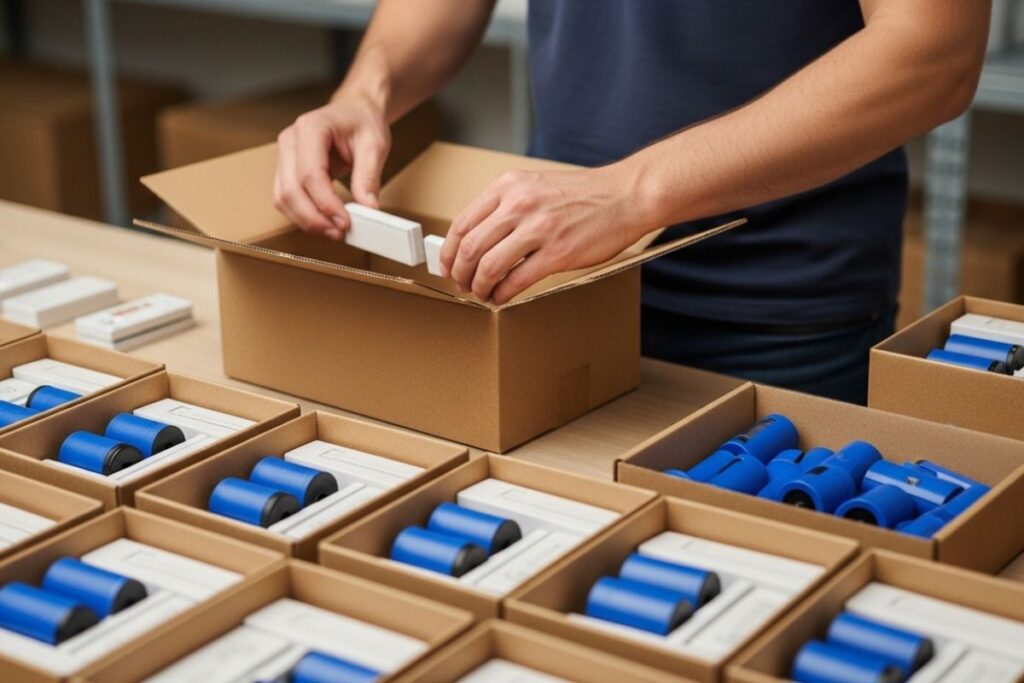
Bundling involves offering several products as one combined product by creating a new SKU. The key difference? Individual items in a bundle usually aren’t available for purchase separately, and bundling is more focused on sales strategy.
Common bundling examples:
- Tech bundles: laptop with mouse, case, and software at a reduced price
- Fashion bundles: complete outfits with tops, bottoms, and accessories
- Home goods bundles: coordinated furniture for an entire room
- Multi-buy offers: “buy 3, get 20% off”
The main difference from kitting is that bundled products remain in inventory until ordered. Your e-commerce platform recognizes the bundle at checkout and deducts quantities from each product’s individual inventory count.
Key Characteristics of Bundling
- Point-of-sale combination. Your e-commerce platform groups products virtually, but your warehouse keeps them separate until orders are placed. This approach eliminates pre-assembly labor while maintaining inventory flexibility.
- Separate SKU management. Each product within a bundle maintains its individual Stock Keeping Unit, allowing the same items to be sold separately or included in multiple different bundle configurations simultaneously.
- Flexible configurations. Businesses can easily create, modify, or discontinue bundle offerings without physical inventory implications. Seasonal promotions, limited-time offers, and A/B testing different product combinations become operationally simple.
- Marketing-driven pricing. Bundle pricing strategies focus on perceived value creation and conversion optimization rather than operational cost savings. Customers buy more when discounts are offered, increasing average order value.
Kitting vs. Bundling: What’s the Difference?
Kitting focuses on efficiency and convenience in inventory management, while bundling is all about sales and marketing strategies.
| Aspect | Kitting | Bundling |
|---|---|---|
| Timing | Pre-assembled before orders arrive | Combined at the point of sale |
| Physical State | Products are physically packaged together | Products remain separate until order fulfillment |
| SKU Structure | New single SKU for entire kit | Multiple SKUs are maintained separately |
| Inventory Tracking | Tracked as one unit; components removed from individual inventory | Each item is tracked individually |
| Flexibility | Fixed combinations; changes require reassembly | Easily modified or discontinued |
| Primary Goal | Operational efficiency and faster fulfillment | Increased sales and higher average order value |
| Assembly Labor | Upfront assembly required | No pre-assembly needed |
| Best For | Subscription boxes, gift sets, and frequently ordered combinations | Promotional offers, cross-selling, seasonal campaigns |
The operational implications differ significantly. Kitting requires warehouse space for assembly and storage of pre-made kits, while bundling needs robust e-commerce platform functionality to manage virtual product combinations.
Third-party logistics providers often offer product kitting services for businesses lacking in-house assembly capabilities, whereas bundling primarily requires software configuration rather than physical infrastructure.
Benefits of Kitting and Bundling for E-commerce Businesses
When used strategically, both strategies have measurable benefits that make businesses run better and make customers happier.
- Increased average order value. Buyers of kits or bundles spend more than buyers of single items. Discounted or curated combinations encourage larger purchases, increasing revenue without adding customers.
- Reduced shipping costs. Kitting multiple products into one package significantly decreases per-unit shipping expenses compared to sending items separately. Consolidated packaging reduces carrier dimensional weight charges, increasing order profit margins.
- Improved customer experience. Thoughtfully curated kits and bundles simplify decision-making for customers overwhelmed by extensive product catalogs. Gift set packaging eliminates the guesswork of selecting complementary items, while subscription box fulfillment delivers discovery and convenience that builds long-term loyalty.
- Inventory optimization: Both strategies help move slow-moving inventory by pairing it with popular items. Kitting transforms excess stock into attractive new products, while bundling creates promotional opportunities that clear warehouse space without deep discounting individual items.
- Faster fulfillment operations: Pre-assembled kits dramatically reduce pick time during order processing. Warehouse teams grab one item instead of gathering multiple products from different locations, increasing throughput during high-volume periods and reducing labor costs per order.
- Enhanced product positioning: Kits and bundles create premium product offerings that command higher price points than individual items. In competitive markets, this positioning boosts brand perception and lets companies compete on value rather than price, protecting margins.
How to Implement Kitting in Your E-commerce Business: Step-by-Step
Successful kitting implementation requires careful planning across product selection, operations, and performance monitoring. Follow this structured approach to launch effective kit assembly processes.
Step 1: Analyze Your Product Catalog and Sales Data
Start by identifying products that customers frequently purchase together using your e-commerce platform’s analytics.
What to look for:
- Review at least 6 months of order history for consistent patterns (not just seasonal spikes)
- Calculate co-purchase rates: divide orders containing both products by total orders for the primary product
- Combinations with 15-20%+ co-purchase rates are strong kitting candidates
Beyond the numbers:
- Do items have similar size, weight, and fragility? (They’ll ship together efficiently)
- Do components have consistent availability or frequent stockouts?
- Are products in similar price ranges?
Also, examine customer behavior like product page navigation patterns and shopping cart contents to understand which items customers naturally associate.
Step 2: Design Your Product Kits
Create kits that deliver genuine customer value, not just random product combinations.

Focus on solving specific problems:
- A coffee lover’s kit: beans, filters, and a travel mug (complete morning routine)
- Skincare starter: cleanser, toner, moisturizer (full routine)
- Tech setup: device + all necessary accessories
Pricing strategy:
- Calculate total component cost (products + packaging + assembly labor)
- Most successful kits offer 10-20% savings vs. buying items separately
- Make sure you maintain acceptable margins
Packaging matters:
- Protect products during shipping
- Create an unboxing experience that reinforces brand value
- Balance premium packaging against additional costs
Step 3: Set Up Inventory Management and SKU Structure
This is where things get technical, but it’s crucial.
- Each kit gets a unique Stock Keeping Unit in your inventory system
- Configure automatic deduction of component inventory when kits are assembled
- Track both individual products and pre-made kits accurately
Set up smart alerts:
- Monitor component availability
- Get notifications when stock threatens kit production
- Set reorder points based on kit demand, not just individual sales
Establish allocation rules:
- How many units go to kits vs. sold individually?
- Prevent strong individual sales from depleting kit inventory
- Avoid excessive kit production that leaves no stock for individual purchases
Step 4: Establish Kitting Assembly Processes
Design workflows that maintain quality while maximizing order fulfillment efficiency.
Set up assembly workstations:
- All components within easy reach
- Packaging materials and tools readily available
- Create assembly instructions with photos or diagrams for consistency
Quality control procedures:
- Visual inspections
- Weight checks
- Periodic full kit audits
- Assign clear responsibility for QA
In-house vs. outsourced:
- In-house: greater control, better for small-scale operations
- 3PL partners: many e-commerce fulfillment services and logistics services in USA offer expertise and scalability for high volumes or limited warehouse space
Step 5: Launch and Monitor Performance
Time to get your kits out there and see how they perform.
Marketing strategies:
- Create dedicated product pages with professional photography
- Write compelling descriptions explaining how products work together
- Consider limited-time launch promotions for initial momentum
Track these key metrics:
- Kit conversion rates vs. individual products
- Impact on average order value
- Inventory turnover rates
- Assembly costs and time per kit
- Customer feedback through reviews
Optimize continuously:
- Adjust kit composition based on feedback
- Refine pricing if conversion rates lag
- Streamline assembly processes as your team gains experience
How to Implement Bundling in Your E-commerce Business: Step-by-Step
Bundling implementation focuses on strategic product combinations and platform configuration rather than physical assembly operations. This approach offers faster deployment and greater flexibility than kitting.
Step 1: Identify Bundle Opportunities
Analyze purchase patterns to discover which products customers naturally want together.
Use your analytics to find:
- Products frequently viewed or purchased in the same session
- Items added to carts together
- Natural complementary products
Strong bundle candidates:
- Tech accessories with devices
- Coordinating home decor items
- Complete meal ingredient sets
- Anything that completes a specific use case
Don’t forget seasonal opportunities:
- Holidays
- Back-to-school periods
- Industry-specific peak seasons
These temporary promotions let you test concepts before committing to permanent offerings.
Step 2: Configure Bundle Pricing and Promotions
Develop discount strategies that incentivize bundle purchases without excessively eroding margins. Calculate the total retail value of bundled items, then determine a discount percentage that creates compelling savings while maintaining profitability. Most effective bundles offer 10-25% savings compared to individual purchases.
Create perceived value through strategic positioning that emphasizes convenience, completeness, or exclusive combinations unavailable elsewhere. Frame bundles as curated solutions rather than simple discounts, elevating the offer beyond price reduction alone.
Design promotional messaging that clearly communicates savings and benefits. Display the individual item prices alongside the bundle price, showing exact dollar savings. Use action-oriented language like “Complete Your Setup” or “Get Everything You Need” that emphasizes value beyond cost reduction.
Step 3: Set Up E-commerce Platform Bundle Functionality
Most major platforms (Shopify, WooCommerce, BigCommerce) offer bundling through extensions or built-in features.
Configuration checklist:
- ✅ Set up bundle products using native features or third-party apps
- ✅ Test that purchasing reduces stock levels correctly for each component
- ✅ Verify that inventory management systems prevent overselling
- ✅ Create compelling bundle product pages
Optimize product pages:
- Clear imagery showing all included items
- Detailed descriptions of each component
- Prominent display of savings
- Customer reviews and trust signals
Step 4: Optimize Fulfillment Workflows
Adjust pick-and-pack processes for efficient bundle handling.
Warehouse organization:
- Store frequently bundled products near each other
- Reduce travel time for fulfillment staff
- Provide clear picking lists that group bundle components
Create a cohesive presentation:
- Even though items aren’t pre-assembled, make them feel intentional
- Use branded tissue paper, thank-you cards, or ribbon
- Visually group bundle components in the shipping box
Is Kitting or Bundling Right for Your Business?
Choosing between them depends on your operational capabilities, business objectives, and customer preferences.
Business size and resources
Kitting: requires warehouse space, assembly labor, and upfront inventory investment. Better for established businesses.
Bundling: minimal physical infrastructure needed. Great for smaller businesses.
Product characteristics
Kitting works well for:
- Physical products that naturally complement each other
- Similar storage requirements
- Consistently purchased together
Bundling suits:
- Digital products
- Customizable items
- Products with highly variable demand
Fulfillment capabilities
Kitting: needs in-house fulfillment or 3PL partners offering assembly services
Bundling: works even if you rely on dropshipping
Primary business goals
Choose kitting when you prioritize:
- Operational efficiency
- Faster fulfillment
- Reduced shipping costs
Choose bundling when you want:
- Increased average order value
- Testing product combinations
- Running promotional campaigns
Customer preferences
Kitting is favored by customers who value:
- Convenience
- Curated selections
- Subscription-based businesses
- Gift-focused brands
Bundling is favored by customers who prefer:
- Flexibility
- Customization
- Promotional-driven shopping
Pro tip: Many successful e-commerce businesses use both strategies simultaneously. Kitting for popular combinations, bundling for promotion,s and seasonal campaigns.
Common Challenges and How to Overcome Them
Inventory complexity
The challenge: Managing component inventory across kits, bundles, and individual sales creates forecasting challenges.
Solutions:
- Implement robust inventory management systems with automated alerts
- Establish clear allocation rules between kits and individual sales
- Maintain safety stock for high-demand components
Assembly costs and efficiency
The challenge: Kitting labor can erode profit margins if processes aren’t optimized.
Solutions:
- Design efficient workstations with components within easy reach
- Create detailed assembly instructions to reduce errors
- Consider automation for high-volume kits
- Outsource to specialized 3PL providers
Platform limitations
The challenge: Some platforms lack sophisticated bundling functionality.
Solutions:
- Research platform-specific bundling apps before implementation
- Test thoroughly to ensure accurate inventory tracking
- Consider platform migration if bundling is core to your strategy
Demand forecasting difficulties
The challenge: Predicting demand without historical data risks overproduction or missed opportunities.
Solutions:
- Start with small production runs to test demand
- Analyze individual component sales as a baseline
- Maintain flexibility to adjust based on early performance
Businesses that sell things online can use kitting and bundling as powerful ways to make more money, run more efficiently, and give customers a better experience.
You can choose and use the strategy that fits your business’s needs and goals if you know the main differences between these two methods: bundling focuses on sales and marketing flexibility, while kitting focuses on pre-assembled operational efficiency.
Start by analyzing your product catalog and sales data, choose the approach that fits your operational reality, and continuously optimize based on performance metrics to maximize the impact of these proven e-commerce strategies.
