

Is it cheaper to transload at the US-Mexico border or use direct through-trailer shipping? Choosing between transloading and through-trailer shipping for US-Mexico cross-border logistics is a cost strategy that directly impacts your bottom line.
According to the Bureau of Transportation Statistics, trucks moved $77.3 billion in freight between the U.S. and Mexico in March 2025, underscoring the growing importance of efficient cross-border shipping.
Direct Cost Comparison: Transloading vs. Through-Trailer
Both methods involve distinct fee structures that can significantly impact your total landed cost depending on shipment characteristics.
Transloading Cost Structure:
- Base transportation rate (origin to border facility): $800-$1,500
- Transloading facility handling fee: $75-$150 per shipment
- Drayage carrier border crossing: $150-$300
- Destination carrier rate (border to final delivery): $900-$1,600
- Total estimated range: $1,925-$3,550
Through-Trailer Cost Structure:
- Direct transportation rate (origin to destination): $1,800-$2,800
- In-bond processing fees: $50-$100
- Border crossing documentation: $75-$125
- Potential detention charges (if delayed at border): $0-$300
- Total estimated range: $1,925-$3,325
When Transloading Costs Less
Transloading can save you serious money in specific situations where its multi-carrier structure gives you more flexibility:
- High-volume shippers win big: If you’re shipping 10 or more loads a month, transloading can cut your costs by 15-25%. You can negotiate better rates with carriers on both sides of the border than you’d get with through-trailer pricing.
- When you’re not in a rush: If your delivery windows are 5-7 days or longer, transloading makes sense. Yes, the handling adds 4-12 hours, but the lower transportation rates more than cover the facility fees.
- The right kind of cargo: Containerized consumer goods, non-perishable food, and durable industrial materials are relatively cheap to transload without much risk.
When Through-Trailer Costs Less
Through-trailer shipping is more economical when speed, security, and minimal handling are your top priorities:
- Time-sensitive shipments: Eliminating the transload stage saves 6-24 hours in transit. For just-in-time manufacturing components or perishable goods where every hour counts, paying a $200-400 premium over transloading is worth it. The faster delivery helps you avoid production delays or product degradation that would cost far more.
- Fragile or regulated cargo: For fragile electronics, temperature-controlled medications, or hazardous materials, keeping everything in one sealed trailer is the obvious choice. Single-load integrity reduces damage risk and can save you $500-2,000 in potential claims and specialized handling fees.
- Lower shipping volumes: If you’re moving 1-5 loads monthly, through-trailer usually costs less. You don’t have the negotiating power to secure competitive transloading rates from multiple carriers, and managing one carrier relationship is administratively simpler.
What is Transloading in US-Mexico Cross-Border Shipping?
Transloading is the process of unloading goods from one trailer or container and reloading them onto another before final delivery. In US-Mexico cross-border shipping, this typically means transferring goods from a Mexican trailer to a U.S. truck at the border.
Why does this happen? U.S. regulations require that U.S.-based drivers and tractors operate on the U.S. side, while Mexico-based drivers and equipment operate on the Mexican side. Each can only operate in their respective country.
Here’s how it works:
- A Mexico-based truck brings freight to the U.S. border
- A drayage carrier moves the shipment from the Mexican side to a transload facility on the U.S. side
- Workers unload goods from the Mexican trailer at the facility
- They reload everything onto a U.S.-based carrier’s trailer for delivery to the final destination
The whole process typically adds 4-12 hours to your total transit time, depending on facility capacity and how complex your shipment is. The upside? You can work with regional carriers who know their routes inside and out on both sides of the border, potentially saving costs and giving you more flexibility in carrier selection.
Common Misconceptions About Transloading
- Myth 1: Transloading is always cheaper than through-trailer. Not true. While transloading can save money for high-volume shippers with flexible schedules, small shippers running 1-3 loads a month typically pay more due to higher per-shipment handling costs and no volume discounts. The cost advantage only shows up when you can negotiate competitive rates with multiple carriers and absorb the 4-12 hour handling delay.
- Myth 2: Transloading is too complex for small shippers. Modern transload systems have actually simplified operations quite a bit, making the process accessible regardless of cargo volume. Yes, coordinating multiple carriers seems complicated, but experienced road freight transport providers handle this coordination for you, making transloading viable even if you only ship occasionally.
- Myth 3: Regulations make transloading mandatory. This is a common misunderstanding. While regulations do require U.S.-based drivers and equipment to operate on the U.S. side and Mexico-based counterparts on the Mexican side, this doesn’t mean you must transload. Through-trailer service complies with the same regulations by using qualified carriers with cross-border operating authority—your freight stays in the same sealed trailer throughout the entire journey.
What is Through-Trailer (Direct) Shipping?
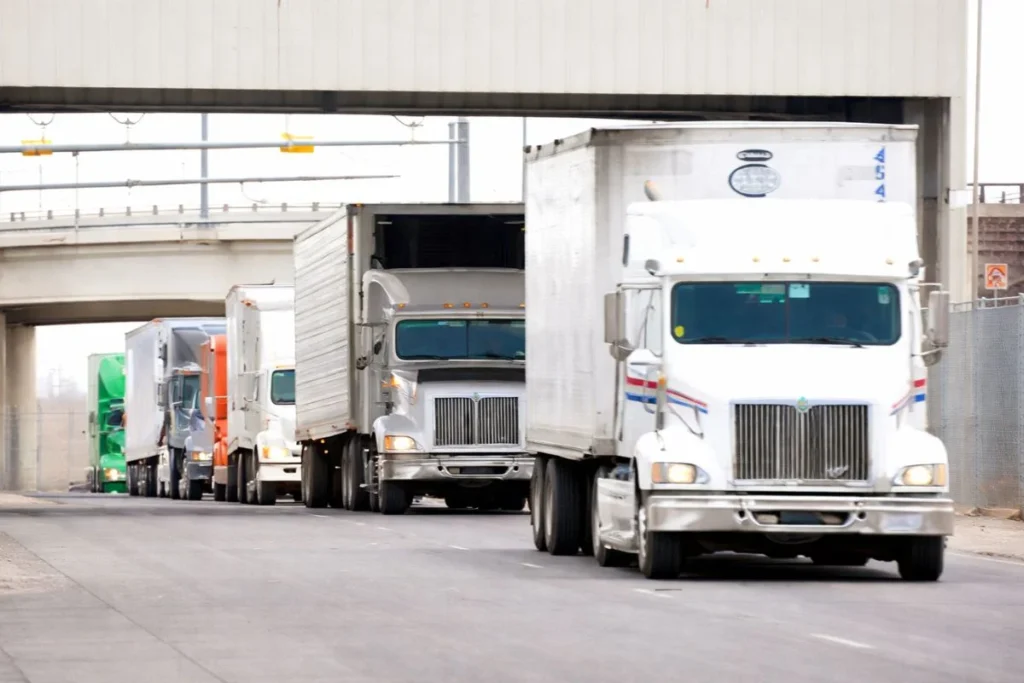
Through-trailer service keeps your loaded trailer in its original sealed container as it crosses the U.S.-Mexico border, eliminating the need for handling at the border. Unlike transloading, which swaps trailers at the border, this approach keeps your goods in the same trailer from start to finish without any cargo transfer.
Here’s how it works:
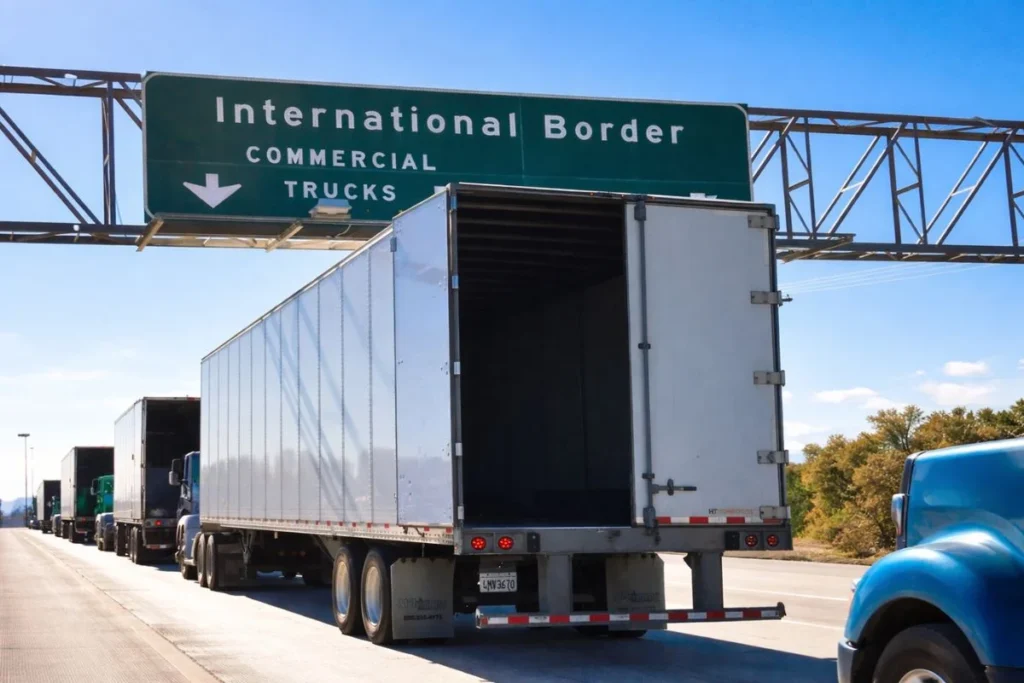
Your goods get loaded into a sealed trailer at the origin point. The carrier delivers this trailer to the border crossing, where it goes through the in-bond process—a customs procedure that allows foreign goods to pass through the United States without formal entry.
At the border, customs officials have the authority to break the security seal and inspect your goods if needed, though many shipments pass with just a documentation review. After clearance, that same sealed trailer continues to the final destination with minimal delay.
The key advantage? This approach typically saves 6-24 hours by eliminating the transfer step. You also reduce handling touchpoints from four (origin load, transload unload, transload reload, destination unload) down to just two (origin load, destination unload). This significantly lowers the damage risk for delicate goods.
Common Misconceptions About Through-Trailer Service
- Myth 1: A through-trailer is always faster. Not necessarily. While through-trailer eliminates transloading time, it’s not immune to border delays. Customs inspections, documentation issues, or heavy traffic can create 2-8 hour delays that wipe out the time advantage. During peak crossing times at major ports like Laredo, through-trailer shipments may actually wait longer than transloaded freight that crosses during off-peak hours.
- Myth 2: Through-trailer means no border delays. A sealed container doesn’t guarantee expedited crossing. Customs officials have full authority to inspect any shipment, and through-trailer loads may face more scrutiny precisely because they haven’t been opened at a transload facility. Random inspections, compliance audits, or security alerts can delay through-trailer shipments just as easily as transloaded freight.
- Myth 3: Through-trailer eliminates all handling risk. Through-trailer does reduce handling touchpoints, but it doesn’t eliminate damage risk entirely. Goods can still shift or get damaged from road conditions, driver handling during coupling/uncoupling, or the extended time in a single trailer. The main benefit is removing the specific risk that comes with the transload transfer, not eliminating all handling issues.
Beyond Price: 4 Decision Factors That Impact Total Cost
Freight Type and Handling Requirements
- Fragile or high-value electronics: Transloading increases insurance premiums by 30-50% due to the extra handling touchpoint. A $100,000 electronics shipment might cost $300-500 more to insure with transloading versus through-trailer, potentially wiping out any base rate savings. The transfer process also introduces damage risk that can result in claims averaging $2,000-5,000 for sensitive equipment.
- Temperature-controlled freight: The 4-12 hour facility dwell time during transloading requires refrigeration during transfer, adding $150-300 in facility fees. Through-trailer maintains an unbroken cold chain, reducing spoilage risk and eliminating the need for specialized transload equipment.
- Hazardous materials: Transloading requires certified handling personnel and specialized equipment, adding $200-400 per shipment. Through-trailer keeps sealed containment throughout transit, reducing regulatory documentation and liability exposure while simplifying compliance.
Speed and Transit Time Considerations
Transit time differences between these methods directly impact your inventory carrying costs, production schedules, and customer satisfaction—all of which translate to real financial consequences.
- Through-trailer’s speed advantage: Typically delivers 6-24 hours faster by skipping the transload step. This is critical for just-in-time manufacturing where production line delays cost $5,000-15,000 per hour. A 12-hour transit advantage can prevent costly production stoppages that dwarf the $200-400 premium over transloading.
- When transloading works: Great for planned inventory replenishment where 1-2 extra days in transit don’t disrupt operations. Retailers restocking distribution centers with 30-day inventory buffers can absorb the delay while capturing 15-25% cost savings on high-volume lanes.
Understanding common mistakes in cross-border trucking helps shippers avoid delays that negate the speed advantages of either method through proper documentation and carrier selection.
Carrier Capacity and Availability
Carrier network access differs significantly between these methods and directly impacts your pricing flexibility and service reliability. The Bureau of Transportation Statistics reports that trucking carries over 60% of surface trade along the Northern and Southern land borders, showing just how dominant truck freight is in cross-border capacity.
- Transloading’s flexibility: Gives you access to broader carrier networks because you can select different carriers optimized for each side of the border. You might choose a low-cost regional carrier for the U.S. leg and a specialized Mexico carrier for final delivery. This flexibility often results in 15-20% total cost savings over single-carrier through-trailer rates.
- Through-trailer’s limitation: Requires carriers with cross-border operating authority, which limits your options to larger carriers with the necessary permits and insurance. While this simplifies coordination and responsibility, the reduced competition can push rates up by 10-25% during peak seasons when capacity tightens.
- Peak period considerations: Capacity constraints affect both methods differently. Through-trailer shippers may face capacity shortages and premium rates when cross-border carriers are fully booked, while transloading offers more flexibility to secure capacity by mixing and matching available carriers.
Risk and Liability Factors
Cargo security, damage liability, and insurance considerations create hidden costs that significantly impact the true economics of each shipping method.
- Through-trailer’s clearer liability: Maintains a single carrier relationship throughout the journey. If damage occurs, responsibility is clear and claims processing is straightforward. This simplicity can save $500-1,500 in administrative costs and legal fees when issues arise.
- Transloading’s complexity: Introduces multiple liability handoff points where responsibility transfers between carriers and the transload facility. Determining fault for damage becomes more difficult, potentially delaying claims settlement by 30-60 days and requiring more extensive documentation. However, reputable transload facilities carry comprehensive insurance that protects shippers.
- Security considerations: Through-trailer’s sealed container provides better theft protection during transit—crucial for high-value goods. Transloading exposes goods during the transfer process, though secure facilities with surveillance and controlled access significantly reduce this risk.
- Insurance costs: Reflect these different risk profiles. Through-trailer insurance typically costs 20-30% less for high-value or fragile goods because there are fewer handling touchpoints. Transloading insurance premiums increase proportionally with cargo value and fragility.
Real-World Cost Scenarios: Which Method Wins?
Analyzing particular shipment profiles with real cost calculations shows how volume patterns, timing needs, and cargo characteristics define the most cost-effective cross-border shipping strategy.
Scenario 1: High-Volume Consumer Goods (Monthly: 15 loads)
- Freight: Packaged consumer products, non-fragile, 40,000 lbs per load
- Route: Dallas, TX to Monterrey, Mexico
- Timeline: Flexible 5-7 day delivery window
Transloading costs: $2,100 per load ($800 origin transport + $125 facility fee + $200 drayage + $975 destination carrier) = $31,500 monthly
Through-trailer costs: $2,450 per load ($2,350 direct rate + $100 border processing) = $36,750 monthly
Winner: Transloading saves $5,250 monthly (14.3%) because high volume enables negotiated rates with multiple carriers, and flexible timing absorbs the 8-hour transload delay without operational impact.
Scenario 2: Time-Sensitive Electronics (Monthly: 3 loads)
- Freight: Computer components, fragile, temperature-sensitive, 15,000 lbs per load
- Route: Austin, TX to Guadalajara, Mexico
- Timeline: 48-hour delivery requirement for just-in-time manufacturing
Transloading costs: $2,650 per load ($950 origin + $150 facility + $250 drayage + $1,300 destination) + $400 insurance premium = $3,050 per load = $9,150 monthly
Through-trailer costs: $2,800 per load ($2,700 direct rate + $100 border processing) + $250 insurance = $3,050 per load = $9,150 monthly
Winner: Through-trailer matches cost but delivers 18 hours faster, making it the clear choice because the speed advantage prevents production delays worth $8,000-12,000 per incident while maintaining equivalent total costs.
Scenario 3: Bulk Industrial Materials (Monthly: 8 loads)
- Freight: Steel components, durable, 45,000 lbs per load
- Route: Houston, TX to Querétaro, Mexico
- Timeline: Standard 4-6 day delivery
Transloading costs: $1,950 per load ($750 origin + $100 facility + $175 drayage + $925 destination) = $15,600 monthly
Through-trailer costs: $2,200 per load ($2,100 direct rate + $100 border processing) = $17,600 monthly
Winner: Transloading saves $2,000 monthly (11.4%) because durable freight tolerates handling well, moderate volume supports competitive carrier rates, and standard timing accommodates the transload process without operational disruption.
Scenario 4: Pharmaceutical Cold Chain (Monthly: 5 loads)
- Freight: Temperature-controlled medications, 12,000 lbs per load, requires 2-8°C throughout
- Route: San Antonio, TX to Mexico City, Mexico
- Timeline: 72-hour maximum for product integrity
Transloading costs: $3,200 per load ($1,100 origin + $275 climate-controlled facility + $225 drayage + $1,600 destination) = $16,000 monthly
Through-trailer costs: $2,950 per load ($2,850 direct rate + $100 border processing) = $14,750 monthly
Winner: Through-trailer saves $1,250 monthly (7.8%) and eliminates cold chain interruption risk worth potentially $50,000-100,000 in spoiled product, making it the only viable option for pharmaceutical shipments.
How to Choose the Right Cross-Border Shipping Method for Your Business
Methodically assess which cross-border shipping method best meets your operational needs and overall cost using this decision framework:
Step 1: Assess Your Freight Characteristics
- Fragile or high-value (>$50,000)? → Through-trailer reduces handling risk
- Temperature-controlled or hazmat? → Through-trailer maintains integrity
- Durable commodity goods? → Transloading acceptable
Step 2: Evaluate Your Timeline Requirements
- Delivery required within 48-72 hours? → Through-trailer saves 6-24 hours
- Flexible 5-7+ day window? → Transloading delay acceptable
- Just-in-time manufacturing dependency? → Through-trailer prevents costly delays
Step 3: Calculate Your Monthly Volume
- 10+ loads monthly? → Transloading enables volume discounts (15-25% savings)
- 5-9 loads monthly? → Compare quotes; either method viable
- 1-4 loads monthly? → Through-trailer simplifies coordination
Step 4: Determine Your Risk Tolerance
- Low damage tolerance or complex liability concerns? → Through-trailer simplifies claims
- Comfortable with multiple carrier handoffs? → Transloading offers flexibility
- High-security requirements? → Through-trailer maintains sealed integrity
Step 5: Consider Market Context
Companies capitalizing on Mexico’s nearshoring wave should evaluate how increasing cross-border volumes affect carrier capacity and pricing for both methods. Understanding cross border logistics cost implications helps optimize method selection as trade patterns evolve.
Decision Matrix Summary:
Choose transloading when you have: high monthly volumes (10+ loads), flexible delivery timelines (5+ days), durable freight, and strong carrier relationships on both sides of the border.
Choose through-trailer when you have: time-sensitive shipments (48-72 hours), fragile or temperature-controlled freight, lower monthly volumes (1-5 loads), or simplified liability requirements.
EP Logistics’ Cross-Border Shipping Solutions
At EP Logistics, we specialize in optimizing US-Mexico cross-border logistics through both transloading and through-trailer services tailored to your specific cost and operational needs. Our extensive carrier network on both sides of the border lets us offer competitive rates no matter which method works best for your cargo.
Our transloading services include:
- Secure facilities at key crossing points
- Climate-controlled options for temperature-sensitive freight
- Hazmat certification for regulated materials
- Real-time visibility throughout the transfer process
For through-trailer shipments: We work with carriers who have full cross-border operating authority, ensuring smooth transit with minimal border delays.
Our approach is personalized: We analyze your cargo characteristics, volume patterns, and timeline requirements to recommend the most cost-effective approach for each lane. Then we monitor performance to identify areas for improvement.
Our Mexico cross-border specialization means we understand the regulatory nuances, documentation requirements, and carrier capacity dynamics that affect both cost and reliability.
Ready to find the best solution for your business? Contact EP Logistics for a tailored cost comparison based on your specific shipping profile. We’ll help you determine which cross-border approach works best for your company.
